
AI Didn’t Replace Jobs. Bad Leadership Did.
Stop blaming the algorithm for management failures.
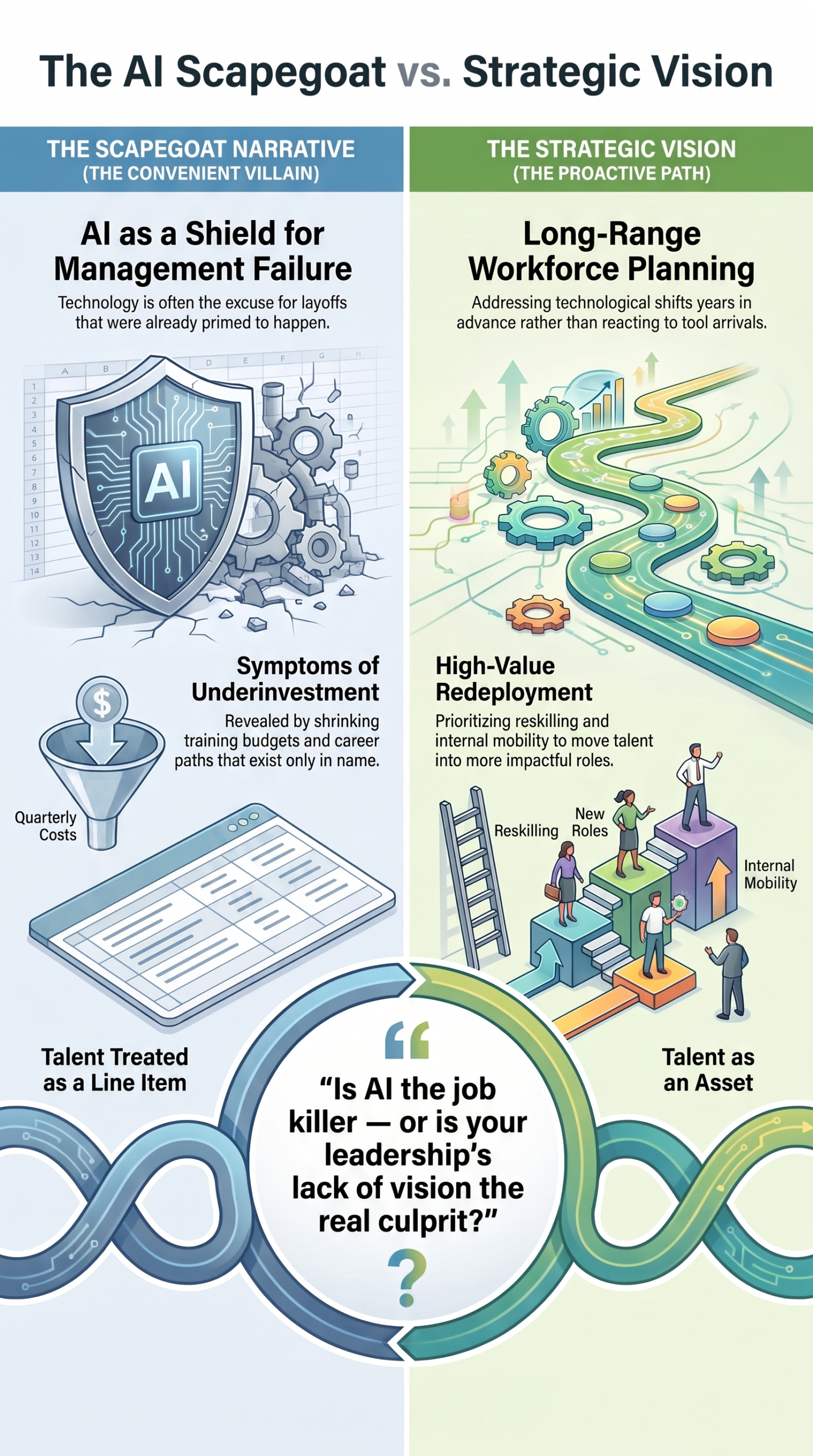
The Convenient Villain
Open any news feed this year and you’ll find the same headline in a dozen different outfits: “Company X cuts thousands of jobs as it pivots to AI.” The story is clean, it’s modern, and it’s almost always incomplete.
AI has become the perfect scapegoat for layoffs. It’s abstract, it’s inevitable-sounding, and — most conveniently for the executives announcing the cuts — it doesn’t talk back. Blaming a technology shift is a lot easier than admitting that a company failed to plan, failed to invest in its people, or failed to build a workforce strategy that could flex with the times.
But look closer at most of these announcements, and a different pattern emerges. AI isn’t usually the cause of the layoff. It’s the excuse for one that was coming anyway.
The Catalyst, Not the Cause
There’s an important distinction between a catalyst and a cause. A catalyst speeds up a reaction that was already primed to happen. It doesn’t create the underlying conditions — it just reveals them, often all at once.
That’s what AI is doing inside a lot of organizations right now. It’s surfacing years of underinvestment in training, years of vague workforce planning, and years of leadership treating “talent strategy” as a slide in a slide deck rather than an actual discipline. When a new tool shows up that can do a chunk of a role’s tasks, it doesn’t take much vision to say “we don’t need as many people doing this anymore.” It takes vision to have asked, five years earlier, “what happens to these roles when the tools inevitably get better, and how do we get our people ready for that shift before it arrives?”
Very few organizations asked that second question. So when the moment came, they had no plan except the easiest one: reduce headcount and point at the technology.
Disposable Talent Was Always the Plan
Here’s the uncomfortable part. If a company can treat a large portion of its workforce as disposable the moment a new tool becomes available, that disposability was baked in long before AI entered the picture. It shows up in:
- Training budgets that shrink first whenever the quarter gets tight, instead of being treated as a core part of the operating model.
- Career paths that don’t exist beyond a vague promise of “growth opportunities,” leaving employees with skills that atrophy in place rather than expand.
- Reorg-by-headcount thinking, where the org chart is optimized for cost this quarter rather than capability over the next three years.
- A leadership bench that talks about people as an asset in the annual report and treats them as a line item everywhere else.
None of that is caused by AI. It’s a leadership culture that was always going to look for the cheapest way to hit a number, and AI simply gave that culture a modern, technologically-inevitable-sounding reason to do what it was already inclined to do.
What Vision Actually Looks Like
Contrast that with organizations that are using AI well. In those companies, leadership treated the arrival of powerful new tools as a workforce planning problem years in advance — not a layoff opportunity in the moment. They asked what tasks would change, what new skills their people would need, and how to build the internal mobility and training pipelines to get current employees into those new roles rather than out the door.
That’s not naive optimism about technology. It’s basic strategic planning — the kind of thing leadership is supposed to be paid to do. The difference between a company that lays off a third of a department “because of AI” and one that redeploys that same department into higher-value work isn’t the technology each company has access to. It’s the leadership decisions made long before the technology arrived.
The Real Question
So the question worth asking isn’t “will AI take my job?” It’s a sharper one, and it’s aimed squarely at the people running the organization:
Is AI the job killer — or is your leadership’s lack of vision the real culprit?
If your organization’s answer to a new tool is immediate headcount reduction rather than reskilling, redeployment, or redesigned roles, that’s not a technology story. That’s a leadership story. And it’s one worth telling honestly, instead of hiding behind the algorithm.
What’s your take — are you seeing AI used as a genuine strategic shift in your organization, or as cover for decisions that were already made? I’d like to hear how this is playing out where you work.

Gina is a certified executive coach specializing in helping business leaders and executives to revitalize their businesses by harmonizing, prioritizing, and strategizing their leadership. She has over three decades of experience in coaching, implementation, and execution and a Wharton MBA under her belt.
Gina’s holistic approach is comprehensive and covers various executive management positions such as sales, business development, HR, OD, marketing, client services, events, financial budgeting and planning, technology, and individual projects within corporate and small business settings. She helps break down strategy and business plans into actionable and achievable execution steps. Her dedication to continuous personal evolution and an extensive toolkit of continuous improvement strategies for her clients to create powerful cultural shifts. Email her at gina@mach4ventures.com.