
Is Your AI Investment Creating Impact or Just Activity?
The Illusion of Progress
Your AI spend is currently a tax on your efficiency, not a driver of it. While boards celebrate the scale of their AI investment, the uncomfortable truth is that for most enterprises, the needle hasn’t moved. There is a massive, expensive gulf between talking about transformation and actually changing how work gets done. Most organizations are trapped in a cycle of heavy spending that produces a flurry of activity but fails to disrupt the legacy processes and structural friction that define daily operations. AI in these companies isn’t an engine of change; it is merely masking structural decay. Strategic intent is being announced at the top, but the ground-level execution remains exactly as it was before the capital was deployed.
The AI ROI problem in large enterprises is characterized by a significant gap between heavy investment and actual operational impact. While many organizations are investing heavily in AI, the primary challenge is that this investment often generates “activity” rather than fundamental changes in how the business runs.
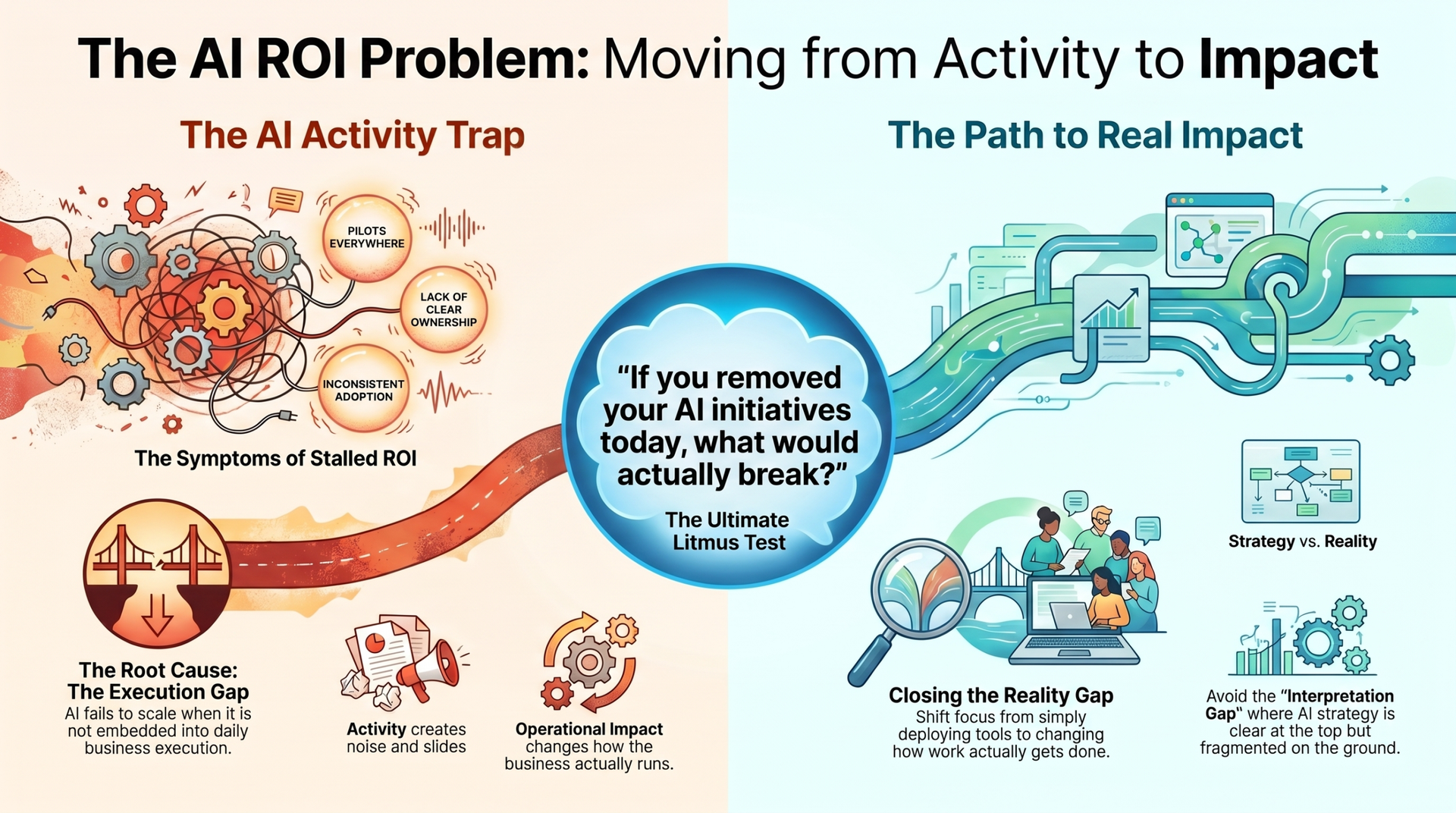
The Symptoms of the “Activity Trap”
The failure of AI to deliver ROI is rarely a failure of the technology itself. It is a failure to embed these tools into the mechanics of decisions and execution. You are caught in the “Activity Trap” if you recognize these symptoms:
· Proliferation of Pilots: AI initiatives stay stuck in experimental phases and fail to scale.
· Lack of Operational Change: The technology is present, but it hasn’t been embedded into the core processes of decision-making and execution.
· Missing Ownership: There is often no clear accountability for ensuring these tools drive specific business outcomes.
· Inconsistent Adoption: Even when tools are deployed, employees often work around them, leading to a “reality gap” between leadership’s perception of transformation and the daily experience on the ground.
The Root Cause
The issue is rarely about AI capability itself; rather, it is an execution problem. AI fails to deliver ROI when it doesn’t change how work actually gets done. When tools are treated as isolated experiments instead of being integrated into the organizational structure, their value remains localized and stagnant.
The “Litmus Test” for AI Value
To determine if an AI initiative is providing genuine ROI, leadership should ask a critical question: “If you removed your AI initiatives today, what would actually break?”.
If the answer is that everything would continue as usual, it indicates that the AI is not yet a vital part of the operating model. Real operational impact is only achieved when AI moves from being a “side project” to a foundational element that, if removed, would disrupt the business’s ability to function.
Why AI Stalls: The Hidden Execution Layer
Even well-run companies fail to scale AI because they ignore the “inconsistent middle.” Strategy looks cohesive in a boardroom slide deck, but as it moves through the organization, it is subjected to the “interpretation of strategy” rather than direct execution. Instead of streamlining work, AI is often layered onto existing complexity, requiring even more approvals and coordination, which ultimately slows the organization down.
The Strategy-Reality Gap
|
The Boardroom View (Intent) |
The Ground-Level Reality (Execution) |
|
Clear, unified strategy |
Inconsistent interpretation of strategy by middle management |
|
Perceived digital transformation |
Alignment paradoxes: more meetings, less clarity |
|
Organized paper-trails and plans |
Decisions slowed by new layers of complexity and coordination |
The Structural Constraint: Cost vs. Operation
Many leadership teams view AI primarily through the lens of headcount reduction. This is a strategic error. Reducing costs without fixing “broken processes” or your underlying operating model does not make a company better; it simply makes it more fragile. When you layer AI over an inefficient structure and cut the staff that was manually managing that friction, you create an organization that is lighter but prone to collapse under pressure. The real constraint to AI ROI is not your budget—it is an operating structure that prioritizes coordination over execution.
Moving from Activity to Impact: The Path Forward
To close the gap between intent and reality, leadership teams must execute three critical mindset shifts:
1. Shift from Experiments to Integration: Stop treating AI as a series of isolated experiments. Focus exclusively on how these tools will be operationally integrated into the daily habits and workflows of the workforce.
2. Prioritize Decision Flow over Tool Deployment: Adding more tools to a slow organization only adds complexity. Identify the points where decisions are made and ensure AI is positioned to accelerate that flow, rather than adding a layer of “coordination theater.”
3. Identify Where Execution Breaks: Diagnose the specific point where the chain snaps. Is the failure in leadership alignment, middle management interpretation, or the execution teams? AI cannot fix a performance issue if you haven’t identified where the execution is failing.
Conclusion: Are You Optimizing or Fixing?
The success of an AI initiative is not measured by the number of pilots launched, but by the fundamental changes it forces upon the business. Organizations must confront the ultimate question: Are you optimizing cost, or fixing how the company actually runs? AI ROI only scales when it moves beyond the pilot phase and fundamentally changes the operating model of the business.
Are you improving how the business operates, or just shrinking it?