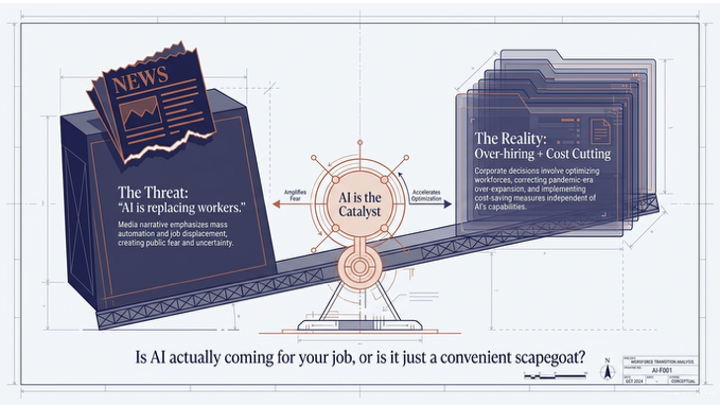
The AI Scapegoat: Is Technology Taking Jobs, or Just Fixing Corporate Bloat?
The headlines are relentless: “AI is replacing workers.” With major companies like Goop recently announcing significant layoffs (they reportedly laid off 18% of their workforce back in 2024 and 20 more people in 2026 to pivot to AI), the narrative that we are in the middle of a machine-driven workforce purge is stronger than ever. But as an AI expert looking at the underlying data and organizational structures, I have to ask: Is AI actually coming for your job, or is it just a convenient scapegoat for “right-sizing” a bloated organization?
The Scapegoat Theory: AI vs. Over-Hiring
The reality of many modern layoffs is often more complex than a simple “robot replacement” story. During recent growth periods, many organizations over-hired, leading to layers of corporate bloat that have slowed down execution and efficiency. In this context, AI is frequently the catalyst used to justify cost-cutting decisions rather than the primary cause of them. By labeling these cuts as “AI transformation,” leadership can frame a painful reduction in force as a forward-looking strategic shift rather than a correction for previous management errors.
Demystifying the “Black Box”: How AI Actually Works
To understand why AI isn’t a “mysterious force” coming to take your desk, we need to strip away the magic and look at the structured, 7-step journey from data to prediction. When we see the mechanics, we see that AI is simply a tool for high-level efficiency, not a sentient replacement for human judgment.
Phase 1: Data Foundations & Pattern Discovery
- 1. Define Features and Labels: The process starts with raw information—like customer behavior—to predict specific outcomes, such as whether a user will remain loyal.
- 2. Exploratory Data Analysis (EDA): Experts study the data for errors and patterns because AI is only as good as the data it learns from.
- 3. Training the Model: The AI analyzes thousands of examples to learn which specific behaviors (like a sudden drop in engagement) lead to a specific result.
Phase 2: Refinement, Validation & Deployment
- 4. Validation and Generalization: A critical step is preventing “overfitting,” where the model simply memorizes old data instead of learning general patterns that can be applied to the future.
- 5. Cross-Validation: The model is tested against multiple data sets—much like a student taking different versions of an exam—to ensure it truly understands the subject.
- 6. Gradient Descent: The model iteratively checks its own prediction errors and adjusts itself slightly to improve accuracy.
- 7. The Final Model: The result is a tested system ready to predict real-world outcomes and trigger proactive business actions.
Efficiency Tool vs. Workforce Replacement
At its core, AI is simply learning from past behavior to make better predictions about the future. When a company like Goop “right-sizes,” they are often looking for ways to handle the same workload with a leaner team. AI facilitates this by automating the predictive tasks that once required hours of manual data crunching.
The question for the modern professional isn’t whether AI is “stealing” your job, but whether your organization is using technology to solve the friction of growth and corporate bloat. AI is a tool for efficiency, and while it may change how we work, the real risk often lies in the structural fragility of a company that grew too fast without the right decision-making flows in place.
Let’s start a conversation: Does understanding the “mechanics” behind AI—this 7-step journey—make it feel like less of a threat and more of a tool? Or are you seeing AI used as an excuse to mask deeper organizational issues?