
The Friction of Growth: Solving Organizational Execution Decay
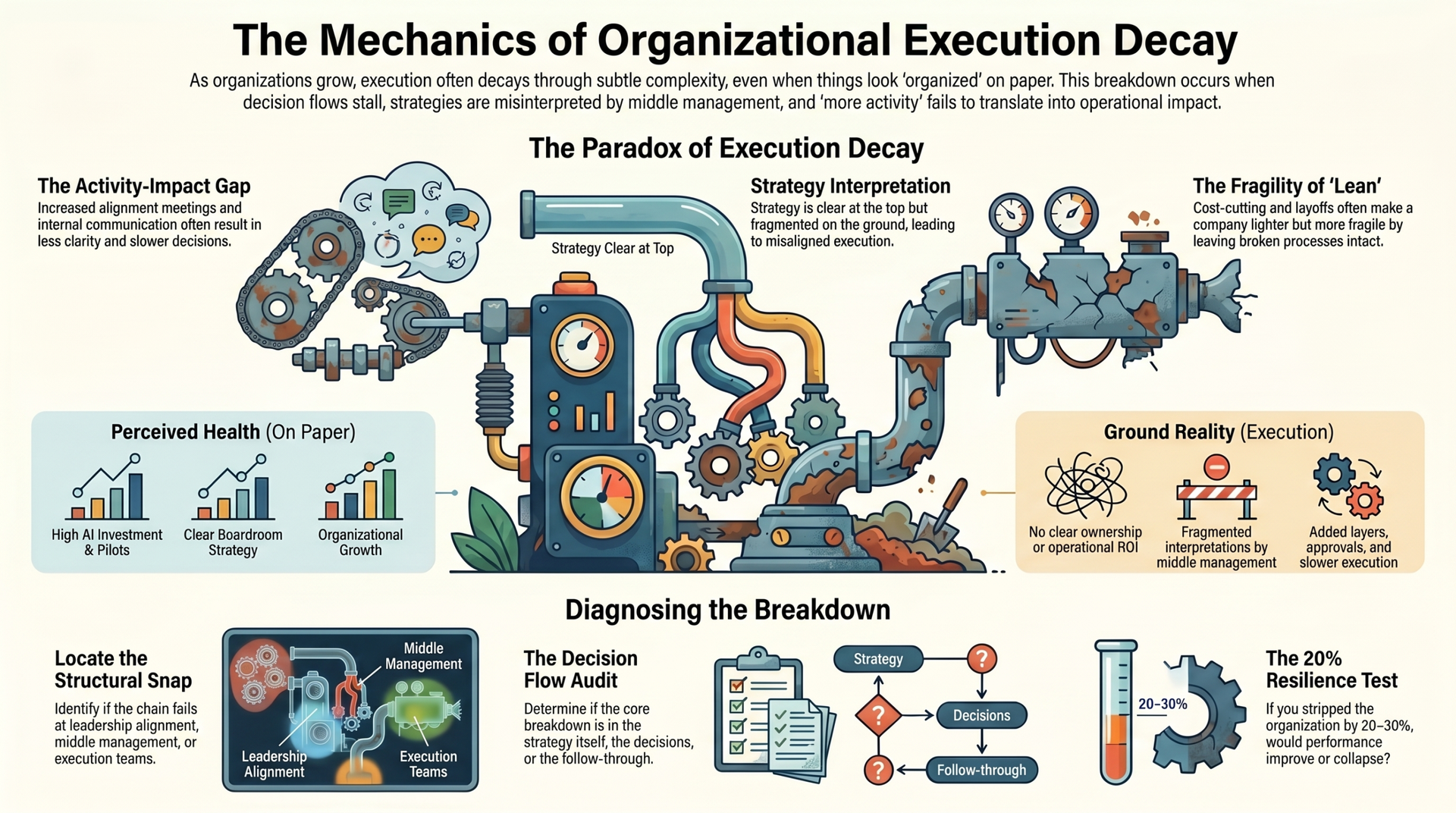
Organizational execution breakdown often occurs in well-run companies as they grow, and it is rarely obvious at first because, on paper, everything still looks organized. Instead of clear failure, the breakdown manifests as a slowing down of the entire operation. Decisions take longer. And adding AI to the mix of creates more chaos and less clarity. We continue this series as part of the analysis of the AI paradox in Execution Breakdown.
Symptoms of Execution Breakdown
When execution begins to fail, organizations typically see a shift where effort no longer correlates with results. Common signs include:
Meeting Overload: An increase in "alignment meetings" that paradoxically results in less actual alignment.
Diluted Focus: A rise in the number of initiatives, which leads to a decrease in overall focus.
Communication Friction: More internal communication happening, but with less clarity for those doing the work.
Operational Overload: The accumulation of too many layers, approvals, priorities, and systems.
The Root Causes
The root cause of this breakdown is frequently found in how decisions flow through the organization. As companies expand, they often accumulate "overload"—more layers, approvals, and coordination requirements—which makes every action feel harder even if nothing appears explicitly "broken". This friction creates a situation where the business may be leaner after cost-cutting or layoffs, but performance remains stagnant or becomes more fragile because the underlying work and decision structures remain unchanged.
Execution doesn't fail because of a lack of effort, but because of structural and flow issues:
Decision Flow "Obstructance": Execution is fundamentally tied to how decisions flow through the organization. When this flow is blocked, decisions slow down, and the connection between strategy and action is severed.
The Interpretation Gap: While strategy may be clear at the leadership level, it often becomes inconsistent in the middle and fragmented on the ground. Consequently, employees end up executing their own interpretations of the strategy rather than the strategy itself.
Complexity and Friction: Growth often introduces more layers and coordination requirements. This creates a "complexity problem" where nothing looks "broken," but everything becomes harder to do, leading to a state of overload rather than productive growth.
Furthermore, a significant gap exists between strategy and reality. While a strategy might be clear in the boardroom, it frequently becomes inconsistent in the middle management tier and fragmented on the ground. Consequently, what is actually executed is often just an interpretation of the strategy rather than the strategy itself, allowing misalignment to build up quietly until it is too late to easily fix.
Diagnostic Questions for Leadership
To move from organizational decay to high-performance execution, leadership must shift their focus from managing activity to optimizing the actual flow of decisions through the company. Your first step is to identify where your execution chain is breaking: is the strategy failing at the leadership level, within middle management, or with the teams on the ground?.
Instead of adding more "alignment meetings" or new initiatives that further dilute focus, prioritize stripping away the layers and approvals that create operational overload. Ultimately, the goal is to stop managing the symptoms of growth—like communication friction and fragmented interpretations of strategy—and start fixing how the organization actually operates to ensure boardroom intent translates into operational reality.Would you like me to create a slide deck that outlines a 30-day action plan for leaders to implement these next steps?
Where in your company does execution break down today—strategy, decisions, or follow-through?
Where does your strategy break first—leadership alignment, middle management, or execution teams?
If you stripped your organization down by 20–30%, would performance improve or collapse?